Welcome

This is the website of the Rotter group at the Institute for Theoretical Physics, Vienna University of Technology (TU Wien). Our main scientific interests are the propagation of waves through complex media, non-Hermitian physics and theoretical quantum optics.

News and latest research

Perfect quantum state transfer in Physical Review Letters

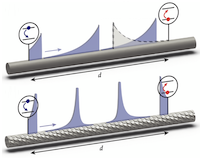
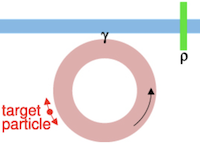
The first paper emerging from our collaboration with Carlos was just published in PRL (open access). Zeyu and Oliver showed both analytically and numerically that placing two qubits in a suitably engineered waveguide results in perfect state transfer between the qubits. Whereas a conventional waveguide results in no more than 54% transfer efficiency (see top panel in the image), our new design reaches close to 100% by inverting the pulse shape (see bottom panel).

Zeyu receives award for best talk

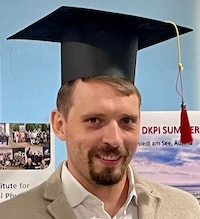
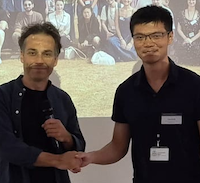
Zeyu (right) received the best talk award at the recent Nanophotonics Science Camp in the UK for his talk on “Adiabatic Energy Transfer in Periodically Modulated Time-Varying Media”. Congratulations to Zeyu, pictured receiving the award from Arthur Goetschy (left), who organized the workshop!

New article in Reports on Progress in Physics

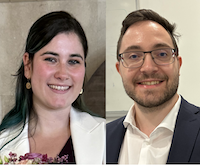
Together with Jan Wiersig from Magdeburg/Germany, we just published an article in Reports on Progress in Physics (open access) that combines two research thrusts in our group: Fisher information (FI) and Exceptional Points (EPs). We demonstrate how EPs can enhance the FI and how moving away from the EP can lead to an even greater improvement in measurement precision. Our work establishes a general framework for understanding the role of non-Hermitian degeneracies in parameter estimation and clarifies under which conditions EPs provide genuine metrological advantages.

Resonant physics of open photonic time crystals

A joint paper with colleagues from Graz and Cardiff has just appeared in Laser & Photonics Reviews. In this work, we develop a resonant-state theory for finite photonic systems that are periodically modulated in time. While these photonic time crystals are often discussed in terms of bulk bandgaps, realistic implementations are finite and open. We show that their dynamics is governed by resonant states (quasinormal modes), revealing how parametric amplification emerges as a resonant process. Congratulations to Adrià, Sergei, David, Egor, Thomas and everyone involved!

BBC Crowd Science

The BBC podcast series “Crowd Science” picked up a question from listener Ahmed from Libya who asks whether light can be cancelled with light. In the corresponding interviews, the editors also want to know whether our work on the “anti-laser” can solve this problem. If you’re interested, check out the podcast.