
David successfully defended his PhD thesis on the Floquet scattering matrix today – congratulations! Many thanks go to our external examinations Emanuele Galiffi (Austin, US) and Henning Schomerus (Lancaster, UK) for evaluating the thesis.
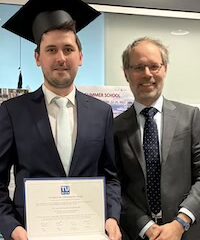
David successfully defended his PhD thesis on the Floquet scattering matrix today – congratulations! Many thanks go to our external examinations Emanuele Galiffi (Austin, US) and Henning Schomerus (Lancaster, UK) for evaluating the thesis.
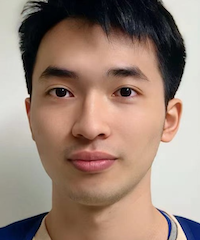
Zheng Gong is visiting us from Xiao Lin’s group at Zhejiang University – welcome to Vienna! Zheng will be working on Fisher information in light scattering and on the interaction of free electrons with laser light.
The BBC podcast series “Crowd Science” picked up a question from listener Ahmed from Libya who asks whether light can be cancelled with light. In the corresponding interviews, the editors also want to know whether our work on the “anti-laser” can solve this problem. If you’re interested, check out the podcast.
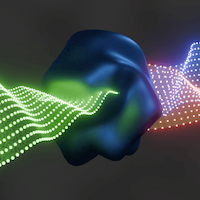
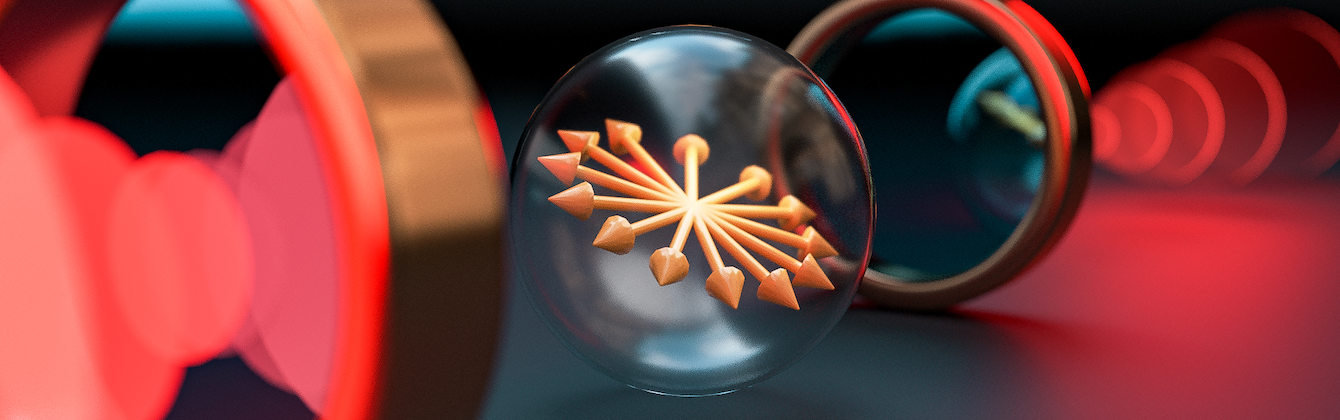
Our recent article with Kostya Bliokh and Zeyu in Reports on Progress in Physics has been selected for coverage in Physics World. Thanks to Paul Mabey for writing this piece and to Oliver for providing the image shown on the left!
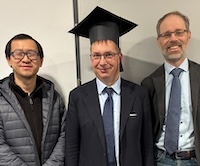
Helmut Hörner successfully defended his PhD on “Spectrally and Spatially Degenerate Coherent Perfect Absorbers and a Renormalization-Free Model for Casimir Forces” – congratulations! Many thanks go to Li Ge (CUNY) and Tsampikos Kottos (Wesleyan) for serving as referees for the thesis. Li even made it all the way from NY City to be there in person for the defense (see photo).
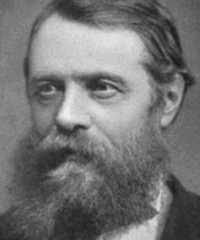
Michael Horodynski, will receive the prestigious Loschmidt prize of the Chemical-Physical Society in Vienna for the PhD thesis he did in our group – congratulations! His prize talk will take place on Tuesday, March 10, 2026, 5:30 p.m. at the Lise Meitner Lecture Hall, Faculty of Physics, University of Vienna.
At the recent NanoMeta conference in Seefeld (Tyrol), Stefan received the EPS QEOD prize for research into the science of light together with our collaborators Allard Mosk (NL) and Dorian Bouchet (F) for “pioneering research establishing the fundamental limits of information and precision in electromagnetic scattering, leading to a quantitative understanding of how light carries and processes information.”
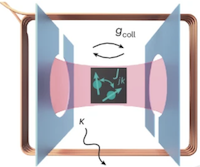
In the group of Jörg Schmiedmayer (Atominstitut), self-induced microwave pulses were observed in nitrogen-vacancy centre spins coupled to a superconducting microwave cavity. With input by Thomas Pohl and collaborators from Japan (Bill Munro, Kae Nemoto), Oliver Diekmann could finally resolve the theory for this puzzling effect – see our new paper in Nature Physics and the corresponding press release.
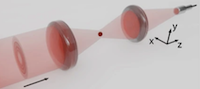
In a collaboration with our former Marie-Curie fellow Nicolas Bachelard from Bordeaux, we have just published a new article in Nature Communications. We show both theoretically and experimentally that tailoring the wavefront of the trapping light allows one to control optical scattering forces and significantly enhance the confinement of nanoparticles levitated in vacuum without increasing laser power. Our results challenge the conventional view of diffraction limited trapping and open new perspectives for optomechanics experiments approaching the quantum regime.

In a collaboration with Kostya Bliokh and Zeyu from our group, we just published a new article in Reports on Progress in Physics. We show there how the decomposition of the phase in a wave’s evolution in a geometric and a dynamic part can be extended to scattering problems – opening up many new and interesting research avenues. See also the highlight by Paul Mabey in Physics World.